Sunday, March 18, 2007

An exceptional album of Irish fiddling and guitar


Up until now, I’ve never really gotten along well with Irish music. I’m not really sure why. I’ve tried a number of times over the years to develop an appreciation but could never really maintain my interest for very long.
It seems like it would be a good fit. It’s music that obviously lends itself well to the violin/fiddle, my main instrument. It has a rustic, earthy character, and thrives in an acoustic setting, all of which I approve of. It has strong ties with American Appalachian fiddle music, which I’ve always enjoyed. Finally, though I’m mostly a mixed bag, I have a large block of Irish blood in me, virtually the only ethnic heritage that I’m consciously aware of. But it just never really clicked. I kind of thought of it like I think of a lot of baroque concerti (such as from Vivaldi or Telemann) - little musical perpetual-motion wind-up machines, having a distinct character as a genre but all tending to sound alike, as well as lacking in drama or structural invention.

But do you ever have that moment when you finally figure out what it is in something that really makes it something? When you realize why people love it? Why they have conventions about it, spend their lives studying it or learning it or living it?

I saw a documentary recently on Charlie Parker, and the anecdote I remember best is a tale about how he used to hang out in a particular bar with a jukebox and he used to fill it up with quarters and play a whole row of country tunes. And everybody would look at him like he was crazy – an incredibly smart, gifted, hip, urban black guy listening to that hillbilly music? They’d give him hell, and he’d just say “Listen to the stories”.

I love that moment when something clicks like that. I’m not near the point where I’m going to dedicate my life to Irish music or anything, but I did have that moment recently. I went down to the grand state of Connecticut to work a music educator’s convention and my coworker was a fellow from Cape Cod who is an Irish fiddler. A beginner, really, having played mandolin for a few years but only a year or two into the fiddle. But he has progressed very quickly, and to my ears (admittedly inexperienced with Irish fiddling) he has a really feel for it, playing authentically in the style. In any case, he was playing a slow tune that I liked and I asked him what it was. He said “It’s an air by Liz Carroll called ‘A Long Night on the Misty Moor.’” An evocative title, I thought, and I went and bought the album a couple days later, which is actually a duo album with Liz Carroll on fiddle and John Doyle of guitar. The title is "In Play".

This album has completely blown me away. In all of a week, I’ve listened to it several times. I’ve simply never heard any fiddling before that has excited me so much, with its style, virtuosity, invention, structure, driving rhythms and overall energy. There’s even a wonderful tension, a suspension almost, to the slower pieces, the waltzes and airs. The ornamentation of the fiddle playing, which before has always seems like just that, ornamentation, comes through in Ms. Carroll’s playing as this endlessly surprising, visceral texture that is inseparable from the melodies and rhythms of the pieces themselves. It adds an incomparable richness to the whole affair without taking away from the exciting direction of the melodies themselves.

Is there something here that has not been there in other Irish fiddle playing I’ve listened to? Maybe. John Doyle’s guitar has been mixed a bit higher than is usual with these recordings, and I really think I’m hearing more harmonic invention and direction in this music than is typical. Many of the development sections and B sections really develop the character and story of the track rather than just seeming to be a linked ‘medley’. There’s a part in track 9, “Freemont Center/The Vornado/Minutemen” which has this feeling of the sun breaking out; you almost can’t avoid picturing jubilant dancing in a sunny green field.

But the best part is, however new and exceptional it might be, it has nonetheless opened up an understanding and appreciation for this type of music that really wasn’t there before. I went back and listened to an album my dad had recommended years ago called “The Lonesome Touch” by the fiddle/guitar duo of Martin Hayes and Dennis Cahill, and enjoyed it much more than I ever had before, especially listening for and noting their differences in style and execution from other players. Martin Hayes has a smoother and more open style, slower and with a more classical touch to his ornaments, certainly less percussive than the more rhythmic and surprising style of Liz Carroll. Both of them have a way with melodies, however. Liz Carroll composes the bulk of the pieces she records herself, and I think she is remarkably talented.

Anyway, if you have even a half-interest in traditional music like this (this album is all instrumental), I urge you to check it out. The album is “In Play” by Liz Carroll and John Doyle.

Monday, March 05, 2007

Another trip to Plum Island

Sunset, looking west through the dune grasses.

Approaching the ocean through the dunes.

A northern harrier, intent on its meal. You can see the owl-like facial disc here.
Well, we had a weekend of nice weather and I got out for some birding yesterday up at Plum Island. Though I must say the conditions were more severe than I expected. Saturday had been very sunny, fifty-plus degrees, and calm, and somehow I dressed as such for my outing on Sunday. I was cold. There was a fierce wind roaring across the marsh from the southwest that cut through my flimsy jacket. By the end of the day my knees were knocking with the cold, my lips were sluggish with the easiest of consonants and my toes were going numb.

Why did I stay out there? Oh, I don’t know. It was still nice to be out after a month-plus of staying mostly indoors. I usually get myself out early but this time I waited until early afternoon, thinking I’m maybe catch the late-afternoon light for once, and maybe the short-eared owls.

I didn’t see the owls! A bit of a disappointment, as they have been seen regularly up at Plum Island all season and a couple others had seen them up at the north end of the sanctuary, flying back and forth over the marsh between lots one and two. The birding in general was unspectacular yesterday but I did have some nice sightings and observations. Two snowy owls, distant looks. Northern Harrier’s were everywhere, coasting low and near, and far, giving great looks of these very interesting and beautiful birds. These may be my favorite hawk to watch, with their wobbly flight and arresting, owl-like facial features. I was lucky enough to watch one dive and successfully catch some sort of bird – I couldn’t tell what kind – and then proceed to tear it apart and eat it. I got a few blurry pictures of it through my scope. But my real luck came as I was watching that and decided to keep scanning with my scope and came up with a rough-legged hawk just fifty yards away from the harrier, on the ground consuming something with a long, narrow tail that was nearly as big as the hawk itself. Though they are sighted regularly this time of year around here, I have only one or two sighting of rough-legged hawks in my life and this was actually my first for Massachusetts. If I did more of my winter birding in the fields and marshes instead of the water I’d probably see more. Both the harrier and rough-legged stayed put for a long as I could stand the wind – I watched for quite awhile as I got colder and colder. Twice another harrier came along and tried to snatch a little bit but was chased off by both birds.

Though I missed the owls, I very much enjoyed being there for the light at dusk. I walked out the boardwalk across the dunes to the ocean and the light from the setting sun at my back lit up the dune grasses wonderfully, giving them a healthy, vibrant golden glow as they bent in the somewhat gentling breeze. I was just going for a quick look so I hadn’t carried my scope, but I could tell that the water beyond the breakers was full of loons and scoters, hundreds, probably thousands of them. It’s neat to see the large congregations of birds massing before migration. I saw the same thing in the eiders in the mouth of the Ipswich river a couple weekends ago, all clustering about ice floes as they drifted out to sea.

The mornings around here have already begun to twitter with a few early-spring songs, from cardinals and chickadees and titmice – Spring is on its way!

Wednesday, February 28, 2007

Have you eaten the food of the Old Country?

Mujadarrah is the dish that made me a cook. It's the one I first took an active, creative interest in, the first one I made, was dissatisfied with the results and resolved to try again, and is a dish that I have continued to make and tinker with every year. It has gotten better and better, then worse with new experimentation, then even better again; it is still short of my memories of that glorious first taste of it at the Old Country Inn in Cincinnati, Ohio.

Mujadarrah, or megadarra, or M'jdara, or perhaps one of any number of other spellings and pronunciations, is a middle-eastern dish of rice, lentils and fried onions. When I first encountered it, it was a steaming, fluffy dish with a slightly sweet, aromatic scent, topped with black, crispy slivers of onion. It was incredible, and kind of blew my top off with its simple yet deeply-rooted implications. I think at that time in my life I had encountered americanized Chinese food and mall-style Mexican combination plates, but no other types of 'non-american' foods. This would have been early college.

I was also nothing of a cook at that time, having only ventured so far as hot dogs, ortega-style tacos and my college staple of macaroni and cheese (mueller's elbows, kraft singles, milk and lots of black and cayenne pepper). After tasting the heavenly dish of mujadarrah in that dimly lit restaurant, I resolved to try and make it. I didn't try and seek out recipes - this was pre-internet and pre-my long-standing addiction to cookbooks, and I didn't really expect to be able to find it anyway, so I did what I rarely do nowadays: I experimented.

In classic beginning cook style, I started by boiling lentils and rice together until mushy and then dumping in enormous quantities of salt, pepper, cumin and turmeric (?). I fried slivers of small onions until golden-brown and mixed them up. It's funny how I either overlooked a fairly obvious procedure (I didn't cook the onions nearly long enough - maybe in the dim lighting I didn't really understand how black they were). It was terrible, but by college standards, perfectly edible and something of a triumph for myself and my housemates, even if I recognized that it wasn't anything like what I had eaten before.
So I began an erratic, long journey to perfect it. The first key step came quickly: fry the onion slices in olive oil until black, and don't stint on the amount of oil. Unfortunately, it took me a long time to realize the second key - stop tinkering with the types and amounts of spices used and just get rid of them altogether (except for salt and pepper). I will admit, I occasionally try a little cumin, but usually regret it, even though I like cumin a lot. The deep, sweet smoky flavor of the onions, the onion-flavored olive oil, the light but meaty taste of the lentils is all you need. The third key was a little trickier, and a tip I got from Paula Wolfhert's recipe, which is to fry the onions first and cook the rice and lentils with a good portion of them (so make sure you cook enough to have plenty for topping) and all the remaining olive oil.

The final key was the trickiest - achieving that light texture, pilaf-style almost, instead of sludge, glop, porridge, whatever. This seems to come from three things - saute the rice and lentils for a few minutes before adding the water, don't use too much water (pre-soaking the lentils helps with this), and have a tight seal (use aluminum foil PLUS a tight lid if possible).

Mujadarrah

Soak 1 cup of lentils in water for a couple hours and drain. Soak 2 cups long-grain rice as well, for at least a half-hour (soaking is not strictly necessary, but helps the texture). Slice two medium-large onions into thin half-circles. Fry in a half-cup of extra-virgin (top-shelf is not necessary - extra-virgin is) until dark-brown to near-black. Remove 2/3's of the onions with a slotted spoon (try to keep as much olive oil as possible in the pot) and drain on paper towels. They will crisp up nicely. Add the drained rice and lentils to the pot along with 2 teaspoons of salt and as much freshly-ground black pepper as you like. Saute briskly for about five minutes (try not to break up the rice grains too much) and then add 4 cups of water (maybe another ½ cup if you haven't soaked the lentils). Bring to a boil, cover tightly (use foil if necessary) and cook for about 25 minutes over very low heat. When done, fluff it up with a fork and serve, sprinkled generously with the crispy onion slices.

In the summer, a simple tomato salad is a great accompaniment. In the winter, try some pan-roasted cauliflower. In all seasons, a spicy yogurt raita is a perfect match, as well as a mint lemonade or a juicy, mineral-ly rose.

Saturday, February 17, 2007

Working with Music

It’s funny how you learn little things about yourself sometimes. Little things that kind of seem obvious, to you, or to anybody else, maybe, after learning them. But we can only muddle through life at whatever pace the combination of mind, matter and luck give us. I learned a little something about myself this week, and I hope the preceding sentences haven’t implied that this is something momentous or of great import. Or of any interest to anybody.

This little mundane thing I learned is that I work better to music. Not all jobs in all situations, of course, but jobs that require me to plow through something, where I’m in my own space, not interacting with others, not too creative but possibly challenging or intellectual…The reason this is interesting to me is because of my distractable, ADD’ish nature – you might think that having music on would be quite distracting, and I always thought so too. But I underestimated the power of distraction. I find that if I’m sitting at my desk slowly working through some kind of project that is not exactly a thrill a minute, my mind goes kind of crazy looking for input, some kind of stimulation, so I get up and pretend to do something else, try and think of questions to ask a co-worker, muse endlessly on what I want for dinner, look something up on the internet, goof off, and so I work in fits and starts. I work quickly and well when I apply myself, so I do get things done. But if I put music on…then there’s that little input, stimulation, there, present, for me to dip into for a few moments, to occupy that unused back portion of my brain as I move through the pages…so yes, the music distracts me, but I stay at my desk. Giving me the chance to be mildly distracted in kind of an ongoing, ambient manner allows me to keep myself from the greater distractions resulting from utter boredom and the need to fill a silent void, and I get more done.

Does this make sense? I don’t know. I’m mostly speaking of my experience of the last few weeks when I’ve been working on a large task of a repetitive nature involving hundreds of pieces of paper, shuffling them and writing things down on them, then transferring those thoughts to some sort of numerical/inventory computer jobbie. I started bringing in CD’s, mostly classical chamber works, and it’s been a lifesaver.

Okay, enough of this rambling. Have I told you I love my new violin? I really do, and I love feeling motivated to practice, and to listen and understand new music. I’ve been listening to Bartok’s 44 Duos for two violins, written in large measure as a pedagogical work, starting from simple and moving to difficult, covering many types of rhythms and melodies, tempos and forms. Many of these duos are under a minute, and few are longer than two minutes. Despite their teaching purpose, these are wonderful character works, covering an immensely wide expressive range, and compressing wonderfully developed musical thoughts and emotions into these incredible little snapshots. Furthermore, listening to them has not only inspired me to play them, it has inspired me to venture again into a bit of composition. Works like these would be a great place to start and experiment. I know the violin, duos would give me greater range, small pieces would allow me to experiment with an easier sense of commitment, trial and error, and I’ve always wanted to explore ‘real’ new music for students and amateurs, a niche extremely undeveloped in the twentieth-century plus world of classical music.

Okay, I’m moving on now. These are just some idle thoughts on a Saturday night. For those who have enjoyed my bird postings in the past, my apologies. I haven’t done much birding recently, but will certainly do some again. Maybe I’ll head up to Plum Island this weekend.

Then again, maybe I’ll stay home and practice my violin.

Friday, February 02, 2007

thank you, George Bryant


Well, I bought a violin. It was made by George Bryant in Lowell, Massachusetts in 1916. I have posted some pictures of it, though predictably, I don't really feel the pictures do it justice. Though its tone is certainly the main thing I fell for, I can't deny a certain appreciation for its appearance and its local New England genesis. Instead of describing it, I'll quote from my appraisal: "The faint to medium flame of the one-piece, quarter-sawn American maple back is horzontal, and is irregular and narrow in width. The flame of the ribs and head is similar to the flame of the back. The golden brown varnish is evenly applied." To my eyes, it glows, but with a subdued, earthy light. It looks its age, yet is in excellent shape, only sporting the odd weathered scratch or irregularity in the wear to its finish.

Falling for this instrument has been an interesting experience. I do mean falling for it, and it really has been similar to the way I have fallen for women before, if considerably less fraught with emotional ups and downs and various insecurities.

I fell for it instantly. In my job I regularly play violins of all sorts of makes and prices, from $100 dollar ebay instruments to antique and modern-made violins up to $25,000 or so (I have yet to play a stradivarius or another of that ilk) - and many of the pricier of these are objectively better than this one - richer, louder, more projection, finer craftsmanship, more expressive versatility - but this one just grabbed me in a completely unpredictable yet natural way within two seconds of picking it up and playing it. I realized very quickly I liked it a lot. A couple co-workers walked into the room where I was playing it and I looked at them and smiled, asking "What is this?" One of them, Vicky, smiled and said "It's nice, isn't it?" I think it was really over at that moment; it just remained to be seen whether we would go the distance or my heart would be slowly be broken. Continuing this rather heavy 'relationship' analogy, I must tell you that we, my violin and I, got married yesterday.

But seriously, folks, I really like this violin. It's very warm and open, with a bit of a dark character to it, a touch of the viola, and a very consistent tone from string to string. It's not loud, but not quiet either. It feels easy in my hands and has a voice like mine - I feel like myself when playing it, while its depth challenges me to develop as a player and a communicator.

I'm hoping that it will motivate me to take my playing to another level. I've been exploring the Bach unaccompanied sonatas and partitas recently, and have been jabbing at a couple movements that I've never attempted before, and still may never be able to pull off, but have always been favorites, such as the first two movements of the first sonata in g minor, the Adagio and the Fuga, and the wonderfully beguiling Andante from the second sonata (perhaps my favorite movement of all). Also, the second movement from Beethoven's violin concerto, which holds some of the most beautifully serene passages, where it seems all the love in the universe is balanced perfectly, comfortably, on the head of a pin.

Anyway, I hope that many of you will get a chance to hear it someday.

Monday, January 22, 2007

Home again, home again, jiggety-jig


Ahh, Cincinnati. I just got home yesterday from a week's vacation in this metropolitan, midwestern city. Not that I really got out to see the town much - most of my time was spent visiting with family (though I did get out for a much needed excursion to the Skyline Chili on Ludlow with my sister Franny). I was lucky enough to be there when my little niece Gabby was there also, and it was certainly wonderful to have another chance to get to know this growing, spirited little girl, now two years old. This was my first time with her since she's been really talking, and she seems quite the smart cookie. I'll tell you, when a little one like her addresses you as 'uncle brian', it's near impossible to deny her whatever it is she wants, so we played several rounds of fun games until she tired of them, or until I tired of them and was able to distract her into a new activity. We played hide and seek, though Gabby hasn't got all the subtleties of the game down yet. When I'm counting and she's hiding, as soon as I yell "ready or not here I come" she runs out of her shady corner straight at me, laughing. We enjoyed several other activities, including sitting in the soft kitty beds at my Mom's house and playing the twirly game.

We also had lots of fun with my sister Esme. It was her birthday on Saturday. We played scrabble and had a chocolate cake, amongst other things. I had to leave Sunday morning during the biggest snow of the season so far, so I missed whatever snowball fights and snow sculptures were enjoyed, and only got the experience the stress of driving to the airport in it with my Dad.

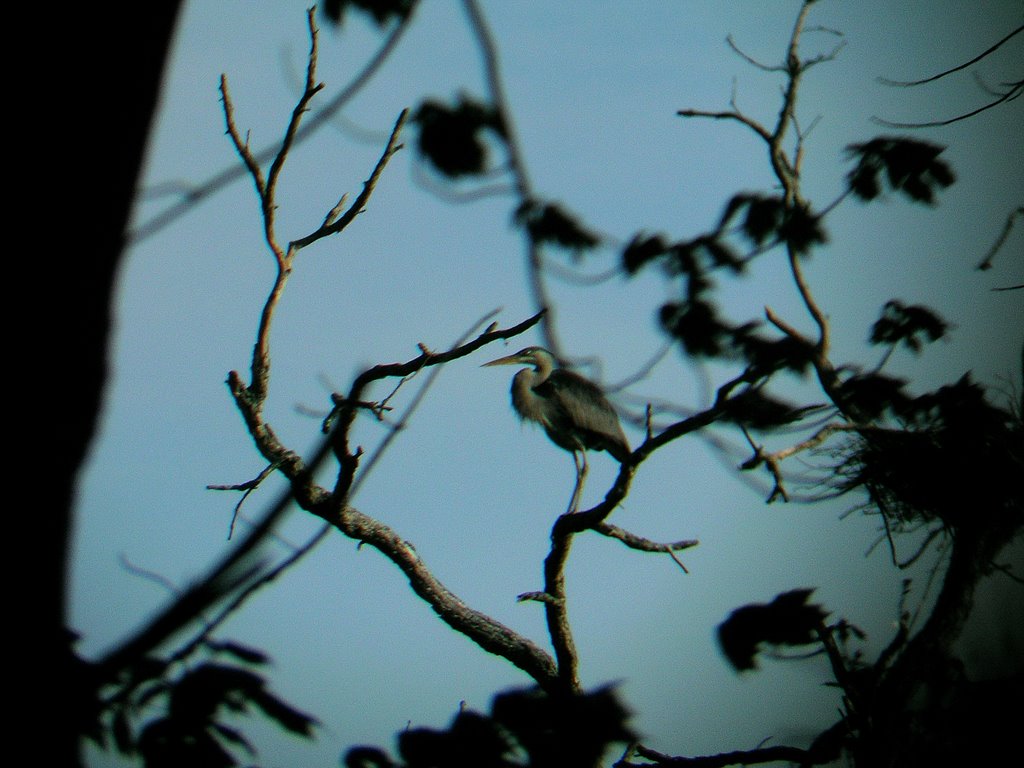
I did get a touch of birding in, though that wasn't exactly a priority. As one might expect from some brief, low impact birding in mid-winter Ohio, there wasn't a whole lot seen, but some nice birds nonetheless. Yellow-bellied sapsuckers were seen on several occasions, Terry and I had a Pileated Woodpecker flyover at the Nature Center, fox sparrows at Spring Grove Cemetery and at Spring Valley, kingfisher, red-tailed hawks, great blue herons, tons of red-bellied woodpeckers...the most interesting sighting of the week was at Spring Valley with my Dad and Lisa of a small flock of Eastern Bluebirds gathering on the ice in the center of the small lake there. I have never seen that before.

Anyway, it was a restful week with loved ones, and sorely needed. Back to work tomorrow.

Tuesday, January 09, 2007

A Simple Meal

Sometimes the best meals are the simplest. Well, not the simplest; in my world that would be cereal, or even a clif bar and a piece of fruit (which is in fact a staple breakfast of my early morning birding). So I guess I don't mean simple in the 'hard day at work, tired, just want to eat something, watch a little tv and go to bed' sense. I just mean a quick, nutritious meal prepared with a minimum of fuss. To tell the truth, many friends of mine, even fellow epicures, would look at what I fixed myself tonight and think that I'm out of mind to go to so much effort just for myself, and on a school night (so to speak, I have never gotten out of the habit of calling any evening when I have to go to work the next morning a 'school night'). But really, it took all of a half an hour, was delicious, and provided me with a well-rounded meal and a pleasant sense of accomplishment from the relaxing, creative energies invoked.

I had a couple of chicken legs defrosted, and had been considering a couple different recipes, a repeat of a chicken with za'taar from the new Ana Sortun cookbook Spice or a braised chicken with olives and saffron from Signor Batali's Molto Italiano. But I was tired, and it had been an irritating, if not particularly long, day, and I wanted quick and easy. So I put some rice in the rice cooker with a dollop of butter and a few pinches of spice from a turkish melange and turned on the broiler. I seasoned the chicken legs with salt, pepper and drizzled with a little olive oil and threw them under the flames. Checking the refrigerator, I found a few lonely pieces of leftover vegetables destined for the rubbish bin (mushrooms, a poblano chile and a couple stalks of broccoli) and cut them up, seasoned just like the chicken and threw them in the oven to roast while the chicken broiled below.

Once eveything was out the the oven and the chicken was liberally doused with my favorite hot sauce (actually, I have many favorites, but the best are made only from cayenne peppers, vinegar and salt) I had a meal fit for a king, or better still, perfectly fit for me and the quiet evening ahead. The chicken was well-charred but still juicy and flavorful (god bless thighs and drumsticks), the vegetables were smoky and piquant and the rice gave me a pleasant, starchy contentment. A half-glass of a light, minerally but juicy rose (don't ask me the grape, but it's not just for summer picnics anymore) made the meal as good as any I've had in a long time. And best of all, cold chicken leftovers for lunch tomorrow.

Saturday, January 06, 2007

The Clouds Break


Okay, first an admission: I did not take this picture. I stole it from the Wikipedia website's article on the dovekie, that tubbly little seabird that sends birdwatchers crazy around here. I wanted to post a picture of it as it represents the high point of a strange, productive and thoroughly enjoyable day's birding on Cape Ann.

There are great advantages to birding in a group; apart from spending time with new or old friends and sharing expenses and driving duties, there is the valuable opportunity to learn from experienced and knowledgeable birders who usually know where the birds are most likely to be found. And, of course, there are all those eyes! Eyes darting everywhere, searching every little branch, wave, rock, whatever that might harbor something that flies (or swims and dives).

I went out with the Brookline Bird Club's outing today, led by Bill Drummond. We started in downtown Gloucester at the State Fish Pier, in a thick fog and intermittent rain (I would say the conditions were chilly except for the fact that we were actually about twenty degrees warmer than we should have been for early January) looking for gulls. In particular, the Common Gull, a possibly European vagrant that's been seen here recently. We didn't see it, but that was fine with me. I'm still in the infancy of gull identification (actually, I might have graduated to toddler this year) - these are difficult birds to distinguish from one another, and great patience is involved when looking for rarities in a giant flock of several hundred flying, swimming, resting and generally wheeling about everywhere in the Gloucester's inner harbor. But we found some others- Iceland Gull, Glaucous Gull and Black-headed Gull along with the more common Herring, Great black-backed and ring-billed. I was especially excited by the Black-headed gull, which I've never seen before and is a smallish gull with a red bill. We watched two of these guys fly round and round a particularly productive stretch of water, occasionally fluttering just above the water and then crashing into it head first, usually coming back up and out with a small, wriggling fish held tight between their bill. Swallow fast or a big bad great black-backed gull will get you!

We moved on to the southern tip of Eastern Point where we saw a distant but recognizable Barrow's Goldeneye. As we walked out the long jetty that is Dog Bar Breakwater, the skies lightened and the temperature rose, but we could see the dense fog still lying thickly about downtown Gloucester.

We kept moving. The whole experience of birding in a group like this is somewhat comical - I would be tempted to make fun of it if I didn't enjoy it as much as I did and respect the other folks who I was birding with. Oh well, I can make fun of myself, can't I? Though we carpooled, there were still several cars full of birders; we kept in touch by FRS radio walkie talkies, which have a range of anywhere from twenty feet to about a mile. As we drove there was constant chatter such as "Redwing, this is falcon one; do you have the eared grebe? Over." or "Put on your left blinker and turn into the Dunkin' Donuts. After a quick pit stop we'll cruise by the Elks Lodge to look for the King Eider. Redwing out." You might have guessed by now that this is a far cry from walking softly in the wilderness; however, once we are out of the cars and in the bird's territory, we are very careful and respectful (of birds as well as private property and general etiquette).

Anyway, we had some good birds, we got the eared grebe and the king eider, as well as purple sandpipers and guillemots and kittiwakes, but the highlight came when we stopped for lunch at Andrews Point, which is just south of Halibut Point (possibly my favorite piece of real estate in Massachusetts). The sun came out here in full force, and I mean full force. Many of us went down to t-shirts at this point and there was actually a warm breeze. Though I find this weather somewhat disturbing and the spectre of global warming frightening, for the hour and a half that we sat on the rocks at Andrews Point I was seriously loving it. Of course it doesn't hurt that we saw the dovekie, and had truly stellar views of it.

Stellar views of a dovekie are different than the stellar views you might have of many other birds. In the dovekie's case, it means several repeated sightings of the bird for the one second it spends at the surface between dives, hopefully from a close enough vantage to actually recognize it. It helps that there's nothing else quite that small, that tubby, with that distinctive tuxedo black and white plumage.

I'm not too humble to mention that I was the first person in our group see it positively - I saw a brief flash of white as something small dove about forty yards off the rocks. I mumbled something about seeing 'something' and kept my binoculars at the same spot, hoping it would come back up within the same view. About ten seconds later it did, and was unmistakably a dovekie, at which point I somewhat overexcitely called it out and somewhat awkwardly tried to describe exactly where it was, or exactly where it wasn't as it kept diving about exactly one second after surfacing. But I kept seeing it rise again and again, about seven times or so, slowly moving left before we finally lost sight of it. Not everybody saw it at this time, which I felt bad about (and wondered if I could have pointed it out better) until we picked it up again about fifteen minutes later. This time, it came in as close as about ten yards and two or three times rested on the surface as long as three or four seconds, a lifetime to a dovekie watcher. Of course, the sun was shining and the warm breeze was blowing, and everybody, myself included, had a very nice smile on their face.

A very nice day all in all. I saw several birds I didn't see all last year: glaucous gull, black-headed gull, king eider, eared grebe, black-legged kittiwake, black guillemot. A nice first outing for 2007.

Friday, January 05, 2007

The Wonderful Lorraine Hunt-Lieberson

I came under the spell of Lorraine Hunt-Lieberson's voice rather late - not in my life, but in hers. She died this last summer at the age of 52, just a few months after I first heard her singing on a recording of two Bach cantatas with Boston's Emmanuel Music on the Nonesuch label. This is an extraordinary recording. Almost every comment I've read about it refers to its 'luminous spirituality', and I can't really say it any better than that. There is an immediacy to her voice, an intimacy in her expression that both astounds but also holds the listener very close, sometimes painfully so. It is hard not to think of her and her illness and of her early death from breast cancer when listening to these pieces; one almost feels she is whispering to you from her bedside (in fact there was a concert staging of these with her in hospital gown).

I've now been listening to two newly-released live recordings of hers, both issued this year after her death. Both are five-song cycles written for her by her husband, the composer Peter Lieberson, both based on sonnets by well-known twentieth century poets. The first, recorded with the pianist Peter Serkin, has settings from Rainier Maria Rilke's Sonnets to Orpheus. The second is from selected love sonnets of Pablo Neruda.

The Rilke Songs, as befits the piano accompaniment and the introspective, metaphysical speculations of the poetry, have a stark intimacy, full of space, angular melodic lines and thin, dense harmonies. This is music that leads one's thoughts into startling, unexpected directions, with few if any resolutions. By contrast, the Neruda songs, as befits the opulence of this most fecund of poets, are lush, and scored for voice and full orchestra, here provided by the Boston Symphony Orchestra under the baton of James Levine. The warmth here is profound, the love palpable. It is in these recordings (or maybe the Bach) that I think I most hear Ms. Hunt-Lieberson's professional beginnings as a violist before her singing career took off, in the nuance of her phrasing, in the clear yet unexpected articulation of her expression. There is humor and play here also, from gentle but deeply embedded latin syncopations to sprightly recurring motifs that arch between the separate pieces. Mesmerizing.

That's all I'll say for now, except to urge anybody and everybody to listen to this music. I can only wish I'd discovered her earlier and taken the opportunity to see her sing live, which by all accounts was normally spellbinding. I'm looking forward to acquiring another recently issue recording of her singing songs by New England stalwart composer John Harbison.

Bye!

Sunday, December 31, 2006

On the last day of 2006...Winter!


Winter finally blew in yesterday, not with a bang, and not exactly with a whimper, but with a modest two-inch snowfall and a chill deep enough to keep the ground white for a couple of days or so. Finally! The warm temperatures of the last month or two have been surprising, even among those of us sold on global warming long ago. I will admit that the warm November was enjoyable, but as it stayed mild well into December it started to seem strange, eerie and finally somewhat frightening, leading me to wonder if the anticipated global or regional climate change will happen not gradually over decades but in some crazy sudden ‘inversion’ that will instantly send our ecosystems spinning. Certainly, it has been an interesting month of birdwatching; from egrets to orioles, many birds have lingered that are normally long gone. I saw a great blue heron today flying across I-95.
So, the snowfall and the dry chill air feels most welcome. I like to think that the resident birds are enjoying it as well. I took a walk today at MassAudubon’s Ipswich River Wildlife Sanctuary and found that everywhere I turned, black-capped chickadees were buzzing about in a playful frenzy, picking their various ways through the winterscape, eking meals out from under leaf, between crevasses of bark, through clumps of snow, always keeping an eye out for a handout as well. They are tame here at Ipswich River, and they will land on your hand if you hold it out, whether it has food in it or not. So will the titmice.
It was sunny today, and other birds were active also, from a beautiful swamp sparrow foraging across the marsh boardwalks to a pair of soaring red-tailed hawks above the swallow field. Actually, my two best birds of the day virtually greeted me as I arrived at mid-morning: a vocal hairy woodpecker hopping along a tree on the edge of the parking lot, and just as I was making my way towards one of the back trails, a beautiful fox sparrow, my third of the year, and certainly a very beautiful bird, maybe (maybe) my favorite of the sparrows, if it isn't the grasshopper sparrow. Or the swamp sparrow.
I also brought along the Golden Guide to Trees today, thinking it would be useful, and enjoyable, to brush up on my tree identification skills which have gone largely dormant, and are more in tune with the Midwest selection anyway. I kept mostly to conifers today, for obvious reasons, and now I feel I know my way around Eastern White Pine, Eastern Hemlock and Eastern Red Cedar reasonably well. This ties in well with an excellent book I’m reading right now called Changes In the Land by William Cronin, which gives a fascinating history of the ecological changes that have occurred in the New England landscape from pre-colonial eras through the settling by Europeans.

It was nice, as usual, to get away from the noise and bustle of the city for a few hours, and the sound of snow crunching under my feet was a great bonus, expected but almost not expected in this strange Massachusetts winter. And a final prize: as I sit here writing this, I am hearing the low, nasal grunt of a fish crow, an uncommon species of crow distinct from the nearly-ubiquitous American crow, which gives me 205 bird species seen (or heard) in Massachusetts in 2006 (220 in North America, if you’re curious).

Now onto my New Year’s Even dinner, an indulgent splurge on a cheap but good cut of steak (chuck blade) and a California Petit Syrah, accompanied by mushrooms and bread.
Happy New Year!


Thursday, December 28, 2006

Crazy names for animals

I wanted to share with you an enjoyable list I found on www.massbird.org. Massbird is an internet site with lots of links and information related to birdwatching in Massachusetts, including a listserve that anybody can write into with unusual (or usual) bird sightings, observations or ruminations. I check it daily. A couple days ago some folks posted a list of literary terms for various multitudes of animals, and I've found them quite interesting; sometimes obscure, sometimes apt, sometimes hilarious. I thought several of them would be perfect novel titles, and lo and behold, a search on Amazon found that some of the best ones already have been used as such. Darn! I was set to title my next book A Parliament of Owls. Apparently these are called venereal terms, and many stem from a fifteenth century source having to do with hunting. James Lipton's book An Exaltation of Larks gives these and many more.
Here they are (there are a couple duplicates; I just cut and paste from two different sources):

cete of badgers
sleuth of bears
sloth of bears
singular of boars [French sanglier]
gang of elk
business of ferrets
earth of foxes
leash of foxes
skulk of foxes
trip of goats
husk of hares
richness of martens
labor of moles
nest of rabbits
dray of squirrels
sounder of swine
pack of wolves
route of wolves

pace of asses
drove of cattle
clowder of cats [clutter]
peep of chickens
rag of colts
brood of hens
drift of hogs
passel of hogs [parcel]
harras of horses
kindle of kittens
barren of mules
span of mules
string of ponies

shrewdness of apes
obstinacy of buffalo
bask of crocodiles
tower of giraffe
leap of leopards
pride of lions
crash of rhinoceroses

school of fish [shoal]
bed of oysters
pod of seals
knot of toads
hover of trout
bale of turtles
gam of whales

dissimulation of birds
sedge of cranes [siege, as in siege engines/cranes; infl. by sedge grasses?]
murder of crows
dule of doves [dule = French "deuil" = mourning/pitying]
pitying of doves
charm of finches
gaggle of geese on water or land
skein of geese in flight
cast of hawks
siege of herons
party of jays
exaltation of larks
tidings of magpies
parliament of owls
company of parrots
covey of partridges
ostentation of peacocks
bouquet of pheasant
nide of pheasant
nye of pheasant
congregation of plovers
unkindness of ravens
building of rooks
walk of snipe
murmuration of starlings
mustering of storks
wedge of swans
rafter of turkeys
descent of woodpeckers
BOUQUET of pheasants
BUILDING of rooks
CAST of hawks
CHARM of finches
CHATTERING of starlings
CONGREGATION of plovers
CONVOCATION of eagles
COVEY of quail, partridges
DECEIT of lapwings
DESCENT of woodpeckers
DISSIMULATION of birds
DULE of doves (a what? "dule" is not in my Webster's)
EXALTATION of larks
FALL of woodcocks
FLIGHT of swallows
GAGGLE of geese
HOST of sparrows
MURDER of crows
MURMURATION of starlings
MUSTERING of storks
OSTENTATION of peacocks
PADDLING of ducks
PARLIAMENT of owls
PEEP of chickens
PITYING of turtle doves
RAFTER of turkeys
SIEGE of herons
SPRING of teal
TIDINGS of magpies
UNKINDNESS of ravens
WALK of snipe
WATCH of nightingales

Monday, December 25, 2006

Merry Christmas, Bird!


Well, once again my photography will not win me any prizes, but it is fun to document a bird here or there. This blurry little guy is a Northern Shrike, seen on Christmas day at the Parker River National Wildlife Refuge on Plum Island. I took it through my binoculars.
The Northern Shrike breeds far to the north and is mostly found around here in the winter. As it is ucommon to rare, as the field guides say, it is an uncommon to rare sighting, but made much easier by its habit of sitting at the top of exposed branches, trees or utility wire. It looks kind of like a mockingbird, but stouter, with a shorter tail and narrow black mask, barely visible in my photograph. I urge all interested parties to go look it up and take a gander; you might see one yourself someday, though in some parts it's easily confused with the Loggerhead Shrike, a close relative.
The Shrike is a powerful predator, taking prey of a size you wouldn't expect from a robin sized bird - I just read an account that had them occasionally taking Blue Jays, which are considerably larger than they are. I think small birds and rodents are more typical.
Anyway, Merry Christmas! I promise a blog about something other than birding soon.
-Brian
ps Some interesting, thrilling and chilling items I've culled from reading Scott Weidensaul's Raptor Almanac. In his discussion of a group of fossil raptors called teratorns, enormous avian scavengers related to condors, he says that the largest of these, and the largest flying bird ever, was Argentavis magnificens from the late Miocene, and that it stood as tall as a man and had a wingspan of around twenty-five feet. Compare that to the ten foot wingspan of modern condors. He goes on to mention, however, the flying reptile Quetzalcoatlus, which had a wingspan of thirty-six feet. Yikes. Finally, he mentions the largest eagle ever, Haast's eagle, which weighed an estimated thirty pounds (compare to about nine pounds for a golden eagle), and fed on moas, giant flightless birds of New Zealand, which were killed off about one thousand years ago. The eagles disappeared about the same time, but Weidensaul quotes biologist Jared Diamond as to his theory - the eagles may have been killed off by humans in self-defense, as the eagles were used to killing and consuming the enormous moas - two legged, strong, flightless birds between three and ten feet tall, and they probably could have made easy prey of the occasional Maori. Wow.

Thursday, December 21, 2006

Home Ground


Here on the first day of Winter, it’s nice to think of the warmth and promise of Spring, even if just for a few moments. Winter does have its charms, but Spring…I was looking through a few pictures I had taken this last April in a local park I often visit, and thinking about how nice it is to have a place nearby that you visit frequently, that you know well, that comforts you and surprises you in the ways that an old and good friend or family member will.
Having been somewhat unsettled through much of my adult life, there’s no place I go now that I’ve known intimately for all that many years. Many people talk of the relationships they’ve had with places throughout their entire lives, or throughout large chunks of their adult lives, but I just don’t really have that. However, for the last three years, since moving to Newton, I have had Hammond Pond.
Hammond Pond, and the adjoining Webster Conservation Area, is a wonderful and surprisingly wild and varied park in central Newton, straddling both sides of the Hammond Pond Parkway, just north of two separate mall complexes in Chestnut Hill. Though I’ve explored both sides, the east side that includes Hammond Pond itself is the place I usually go. It’s on my way to work, and easy to stop off at for a few minutes (or few hours, if I get up early enough) of birding and tramping about before clocking in. The pond itself, which borders the mall parking lot on the south and an inaccessible red maple swamp to the north, often harbors surprises for those who take the time to scan the water and the trees bordering this small lake. The water is often full of ducks, geese and gulls; in the Spring wood ducks are always present paddling and dabbling along the western shore, and can often be found sitting in nearby trees as well. Before and after ice out there are usually numerous hooded mergansers diving for fish. Two weeks ago I saw one struggling with a sunfish as big as its head; as if that wasn’t enough trouble it was soon attacked by a herring gull which forced it to dive again and again, always resurfacing with the fish still in its beak. Eventually it made its way over to the water’s edge; the gull gave up as it hid itself in the overhanging brush there and finally consumed its enormous meal. Great blue herons are often seen here, ospreys not so often but on a few occasions.
Entering the woods you quickly pass beautifully sculpted cliffs of Roxbury pebblestone that sometimes hold climbers on the weekends. When the palm warblers arrive, usually among the first warblers to do so, they jam this stretch of trees in considerable numbers and think nothing about going about their business not ten feet away, singing their feeble trill and constantly flicking their tail as they forage in the low, open undergrowth.
Just a few minutes of walking brings you to a short dip down into the Webster Conservation area, where a small, clear brook babbles along into a wetland area, a peat bog. Skunk cabbage abounds, and this is usually the first place I spot migrating hermit thrushes, hiding in plain sight in their peculiar and endearing manner. This wetland appears wildly different at different times of year, or even from day to day according to the amount of rain we've been getting. Sometimes it is lush and picturesque, full of frogs and swimming ducks, herons and kingfishers. Other times it is a dank mudpit, and sometimes it appears as a dry, stubbly field bunched with clumps of brown marsh grass along its margins. Once again wood ducks are dependable if there is water to be found. There are always song sparrows, but that is no surprise. I have seen, twice, a coyote trotting along the train tracks on the far side. And some incredible, unseeable species of frog makes the most amazing, bubbling, endless trill in the early mornings, one frog harmonizing with another at strange, jarring intervals.

Moving along, before I cross the train tracks there is a little spot up from the wetland where I look and usually find an ovenbird skulking about the logs and leaf duff in early May. Crossing the tracks finds me in the Houghton Gardens, a more manicured garden area with benches, carefully placed stone steps and small arched bridges over narrow, shallow waterways. Warblers are plentiful here.

Coming back, I skip the wetland and instead head up along a back trail to the top of the bluffs we passed earlier, finding myself in perhaps the most surprising place of all, a rolling open shelf of rock and thick, verdant moss, with views over the high ledges to the pond and swamp below. This place never fails to thrill me with its fragile beauty and unexpected character; the dense heterogeneity of this entire property is a marvel, surrounded by residential neighborhoods, highways and shopping malls, five miles down the road from Boston.


Sunday, December 17, 2006

An important milestone we should all celebrate. Not really.


I tell myself, and others, that as a birder, I’m not all that interested in numbers or obsessive ‘listing’, as it’s often called. Simply, listing is making a list of the birds that you’ve seen. Easy enough, no big deal. The most basic form is the ‘life list’ – a list of all bird species that you have ever seen. Many people take it one or two, or ten or twenty, steps further. There are country lists, state lists, city lists, park lists, backyard lists, lists of birds seen on television, bird calls heard on television or radio, birds referred to in books or poetry. Then there are year lists, month lists, behavior lists (singing, feeding, copulating…), the possibilities are endless. This, along with the mental and physical challenge that is a real part of birding, is what makes it kind of a sport, and what spurs many people to bird competitively, trying to rack up as many species as they can, sometimes in conscious competition with other birders (the most famous competitions are the ‘big day’ and the ‘big year’ – you can probably guess what these mean).

As I said, I don’t really consider myself a die-hard lister, most of the time. I have a life list, and I keep a year list, and I keep records of species seen on most outings I take. But I don’t tend to drop what I’m doing in order to chase down one rare bird, and I don’t make much of an effort to tally as many species as I can in a year, or even a lifetime. I’ve got other things I also like to spend time on, though birding is near the top of the list. In this way, I sometimes think of myself as a ‘birdwatcher’ instead of a ‘birder’, being more interested in watching the birds and learning about them, enjoying their beauty and the intricacies of the world they fit into rather than quickly checking them off and moving on to the next.

This is somewhat true of myself, but also somewhat false. Today I found myself birding with moderate fervor, and a specific goal in mind: to reach two hundred species in Massachusetts for the year 2006.

I was successful.
A few weeks ago, I looked over my year checklist and found that, after having birded frequently in the Spring but not having done much since then, I had seen about 180 species in Massachusetts for the year, and remembered telling myself that it would be nice to reach or break 200. So I thought, ‘I can do this.’ Over the next couple weeks I added new birds here and there, some waterfowl species at the Great Meadows National Wildlife Refuge in Concord one weekend, a couple of sparrow species at Nahanton Park in Newton another, meadowlarks (which I had somehow missed in the Spring, despite their lovely song "springtime is here") at MassAudobons Daniel Webster Wildlife Sanctuary last weekend…

This morning my tally stood at 196. One thing I hadn’t done all year, either this Fall or last Winter, was hit Gloucester and Rockport (except for Halibut Point, which I visit frequently, but often to go snorkeling rather than birding). There are a lot of wonderful birds to be had in Gloucester, but it’s not usually my favorite type of birding, as Gloucester is pretty well developed and birding mostly involves driving from site to site, getting out of the car and scanning with binoculars or scope along the way. I generally prefer to pick a location where I can get out and hike or walk for some distance. But like I said, there are good birds to be seen in Gloucester, and some more likely to be seen there than any other place around here.

I started at the Fisherman’s Monument by Gloucester Harbor, and found the wind blowing in from the south quite fiercely, making holding my scope steady or even my binoculars difficult. I found some common eider and red-breasted mergansers, but didn’t have the patience or will to really clamp everything down and scan from there for the uncommon gull species that I’ve seen there before.

So I moved on, and that paid off. At the State Fish Pier the wind was still fierce but it was just a bit more sheltered and I could crouch by my car to steady myself (at least it wasn’t cold). Almost immediately I had a tremendous view of a female scaup, a type of waterfowl, paddling and diving around a floating wooden dock laden with a motionless cadre of double-crested cormorants. There are lesser and there are greater scaup, and with both female and males it is hard to distinguish between the two species, but this bird was close and stayed close as long as I was there, and between the larger bill size and the shape of its head, peaked in front, calling it a greater scaup was fairly easy.
One down!
Next I began to scan gulls, never one of my favorite birding activities. Gulls mostly all look alike, but there are two straightforward things you can do to zoom in on most of the rarer ones in New England, at least in Winter. Look for very small gulls, and look for larger gulls with no dark brown or black markings on their wingtips. These latter are what we call the 'white-wing' gulls, consisting mostly of Iceland and Glaucous Gulls.

Success, and two down! Another great view, this time of an Iceland gull, a mid-sized gull that winters here in modest numbers, amidst the many thousands of ring-billed, herring and great black-backed gulls that abound in these parts, nowhere more so than the Gloucester Harbor.

I then moved south along the eastern shore of Gloucester Harbor to eastern point, where I saw nothing new for the year, but did see a sizable flock of purple sandpipers on the big jetty there, more hordes of gulls, more eider and a small group of the fun-loving buffleheads. Driving out from the point I stopped at Niles Pond where there was a nice flock of bonaparte’s gulls, to my eyes an exceptionally elegant small gull with a fine black bill. I don’t often see these resting so placidly on a pond, usually I’m trying to make out the field marks on a considerable chop out at sea, so I took my time looking at them and making mental notes about plumage and shape.
This was not a new bird for the year, but a friendly birder at the pond reminded me of a rarity that has been haunting that neighborhood the last week or so, a western kingbird, a large flycatcher usually seen, as if you couldn’t guess, in the west, but a rare but regular vagrant across the eastern United States. So I found a parking spot by the beach and walked over to 10 St. Louis Street off of Farrington, and almost immediately found it preening itself high in a bare tree just below a small congregation of house finches. Superficially this bird resembles a great-crested flycatcher, which is easily found in Massachusetts woodlands during the Spring and Summer, but has more dark/light contrast between its head and chest and a noticeable black line across its eye. It also holds itself more horizontally. Despite belonging to the flycatcher family, this one has been eating berries (though with our warm weather so far, I'm sure there are plenty of flies still around. Ticks, too). Plus, one thing you learn, if you see a bird you don’t expect for the time of year, look more closely – it might be a completely different kind of bird that’s completely off your radar, a vagrant from worlds away.

Three down!
The last bird was the most fleeting but the most exciting, as it was a bird I’ve been hoping to catch a glimpse of for years but never have until today, the lovely oddball, the flying football, the dovekie. This is a type of alcid, a group of tubby ocean birds usually draped in bright white and black that normally stay well away from land, diving endlessly for their meals, at least when they're not breeding. These are the penguins of the north, but they can fly, barreling along just above the surface of the water with considerable speed, if not much grace. The dovekie is the smallest alcid in the east, and the tubbiest as well. It really is quite small, and I nearly mistook it for a sandpiper at first from its size, but noticed right away its distinctive shape (football) and coloration (tuxedo) and manner of flying. If it had been off on the horizon, I may not have been able to judge size or shape well enough to really distinguish it from another type of alcid like a razorbill (or I wouldn’t have been able to see it at all), but it was pretty close in, maybe a hundred, hundred and fifty yards out or so, flying south past the Granite Pier in Rockport into the small bay there. I watched it for about six or seven seconds, heart thumping, hoping to see it splash down and get a chance to watch it feed. No such luck. I suddenly lost it, mysteriously, in mid-flight in the sun’s glare on the water. I scanned for maybe fifteen or twenty minutes more, but could not turn it up again, but…it had to be there, somewhere.

No big deal. Four down, and a lifer for my 200th Massachusetts bird species seen in 2006.
Happy Holidays!
(p.s. the photograph has nothing to do with this post. I didn't take any pictures today, but feel that a photograph might help people enjoy my blog, so I included one of my favorite pictures from Costa Rica 1990. It's a picture of a damselfly.)

Friday, December 15, 2006

Have you heard Joanna Newsom's new album?

The name of the album is Ys, (1 point if you know the old French folk tale, 2 if you know the excellent Debussy prelude inspired by that tale), and I hesitate to recommend it, as Ms. Newson’s voice is an acquired taste. One I’m not sure I’ve even fully acquired yet. It’s odd, squeaky and strangled, flighty and warbled, like a record on an old turntable set somewhere between 33 and 45 rpms. The first time I heard her sing, on a track from an earlier album, I hated her voice, really, thinking it full of fakery and strained effect, but even then I was paying attention to her harp playing and her hypnotic and enticing melodies.

In any case, I felt I had to check out her new album after reading a considerable number of intriguing and positive reviews, notably Sasha Frere-Jones' from The New Yorker and the one from the sometimes-irritating Pitchforkmedia.com site. There are only five tracks on the new album, all lengthy affairs full of the constant motion of her harping and her singing, and four tracks also have highly imaginative and unpredictable orchestral scoring by Van Dyke Parks. Her songs seem to consist of long sequences of her simple harmonic progressions, one after another, after another, endlessly strung with her voluminous and poetic lyrics. I say poetic, and I think I mean it. Each song reads like a long, imaginative work of poetry; whether it’s good poetry or bad poetry, I’m not really sure, but it seems to hold my attention, obliquely touching on themes of family and work, and art and music, myth and history, and who knows what else, replete with details from the natural world, minnows and bears and meteors…I like it.

And the orchestration is great, shimmering with ideas, buffeting the melodies and lyrics like the various waters and worlds surrounding a small boat passing downstream on its way to the ocean. (That analogy was a bit much, wasn't it?) Mr. Parks has worked on many other notable projects, including the finally-last-year-released SMILE album from Brian Wilson, a couple tracks with Sam Phillips (one of my favorite singer-songwriters of the 90’s), and some work of his own. I have an album of his called Song Cycle. I hated it when I first played it, and shelved it for three years, only pulling it out a couple weeks ago after hearing Ms. Newson’s new album. Now, well, I like it, but haven’t really fallen for its willful eccentricities yet.

Anyway, regarding Ys: it seems to have caught me. I’ve played it through a few times in just a couple of weeks, a rare event these days for me, especially for anything related to the popular music world. Maybe this is music far removed from that world, but I don’t think so. It’s less complicated music than the recent press would have you believe, less complex than you might think at first from its unique instrumentation and long, poetic structures. It is accessible and straightforward music, done with personality and imagination, and worth checking out.

My apologies if her voice makes your cat cry.

Monday, December 11, 2006

Winterberry and the misfit goose


Winterberry is one of the standouts of the wintry New England coastline, often providing the only splash of bright color amidst the muted browns, greens and tans of dune, scrub and field. I love in particular their contrast against the small dark green juniper shrubs when they grow together in the shallow, stable depressions between windswept dunes. By mid-winter they often seem to be the only berry still available, and an important foodstuff for wintering birds and animals that enjoy berries. Myself, I’ve never tried one. I did notice signs posted at the entrance to the Parker River National Wildlife Refuge today to leave the berries alone. I think, however, that they are often collected for holiday decorating, not as a tasty addition to your yogurt.
Birding today was a little quiet, especially once the drizzle began around nine o’clock or so. I missed most of the more exciting birds posted on the chalkboard – the shrike, the owls, the Eurasian wigeon and the kittiwakes. I had to make do with excellent, close views of several other expected but enjoyable species, including Common and Red-throated Loons, Red-necked and Horned Grebes, Common Goldeneyes, all the scoters, the Common Eiders…and a few other things.
Interesting behavioral note: I watched a group of seven female Common Goldeneyes for several minutes. They always dove as a group, either all at once or in quick succession, and surfaced quickly, usually within six or seven seconds, which is shorter than most of the other diving birds, I think. I wonder what sort of group hunting formation they use, collaring schools of small fish and driving them towards each other. What a cold observation project that would be!
Northern Harriers seemed to be everywhere, and I still have yet to have a dull moment watching them hunt and they wobble and drift above the marshes. Most of the individuals seem to be immatures, showing that beautiful reddish wash on their breast. I also had great views of a Cooper’s Hawk along the roadside.
The bird of the day was the Snow Goose, a single individual grazing amidst a large flock of Canada Geese. I included a picture here to demonstrate my great skills at photography. Despite its blurriness, I think you can see the diagnostic black wingtips and maybe the pinkish color of the bill, maybe not. You can see that its white, and clearly not a Canada Goose, can’t you?


Monday, December 04, 2006

Snowy Owls!


Man, when I get the birding bug, I really get it. After a very full Spring of almost daily trips near and far throughout eastern Massachusetts, I went several months with only a trip or two every few weeks plus some incidental roadside and vacation birdwatching (thus missing the heights of the fall shorebird, sparrow and raptor migrations). But with the end of the year approaching, it got into my head to see if I could bolster my list to 200 species seen in Massachusetts this year, and I've been out nearly every day for over a week. Though I haven't really done the job I need to if I want to add species - there are rarities to be chased down on Cape Cod, and a full swing through Cape Ann might turn some things up, but alas, I have to work and there have been other (albeit enjoyable) commitments preventing me from going at it full time on the weekends. And now it's snowing! (Plus laundry, library, clean room and kitchen, practice violin, rehearsal, grocery shopping...) But I just can't get the birdies off my mind, have several guides by my bedside that I am leafing through idly.

I should go chase the Bell's Vireo down in Falmouth, but...an hour and a half drive each way, an unknown location and unclear directions, a possibly several hour wait with no guarantee of success for one bird, well...I'm just not up to it today. Not without company. Too much driving. Why does that make me feel guilty? Less than dedicated? To those birders who might be reading this whose perseverence stretches beyond my own: my apologies.

In compensation, here are two photographs of the Snowy Owl that I saw yesterday at the Salisbury Reservation on the northern mouth of the Merrimack River. My friend Anne has a sixth sense for these wonderful birds and spotted it on a dumpster as we were leaving the park. It soon flew (the first time I've ever seen a snowy fly in ten-plus sightings!) and perched for several minutes on the maintenance building where we got some pictures. Otherwise, it was quiet at Salisbury, but a few nice birds were about - Long-tailed Ducks, Eider, Common and Red-throated loon, Red-Breasted Mergansers...the short-eared owls hadn't arrived yet.

Did I mention that it's snowing?

Monday, November 27, 2006

Harlequins!


You know, as a birder, and as a person, I try not to play favorites. It’s a fun exercise, no doubt, and the kind of top-ten list making that starred in the novel High Fidelity can easily consume hours of idle thought. But really, I find that these favorites are in a constant state of flux, changing by the year, week, day, or minute. Often, my favorite is whatever is staring me in the face at that particular moment, which is as it should be. A few things certainly stay near the top of the list for long periods of time. For me, musicians such as the Beatles and Mozart, movies like Jaws and ET, books like The Lord of the Rings and Dune will always be near the top.

Birds are different. I have so many favorites. There are birds such as the Black-capped Chickadee, which reliably entertain me with their familiar chatter and antics at any time of year. I see them almost every time I venture outside, and they are familiar friends. There are birds like the Wood Thrush, which send a thrill through my ears and my soul when I hear one for the first time every Spring, singing with a voice at one with the heart of spring and the woods, but also speaking from just on the other side of some parallel world beyond my reach. That was a little over the top, wasn't it? And of course there are the memories or anticipations of rare thrills I get from such birds as razorbills or phalaropes.

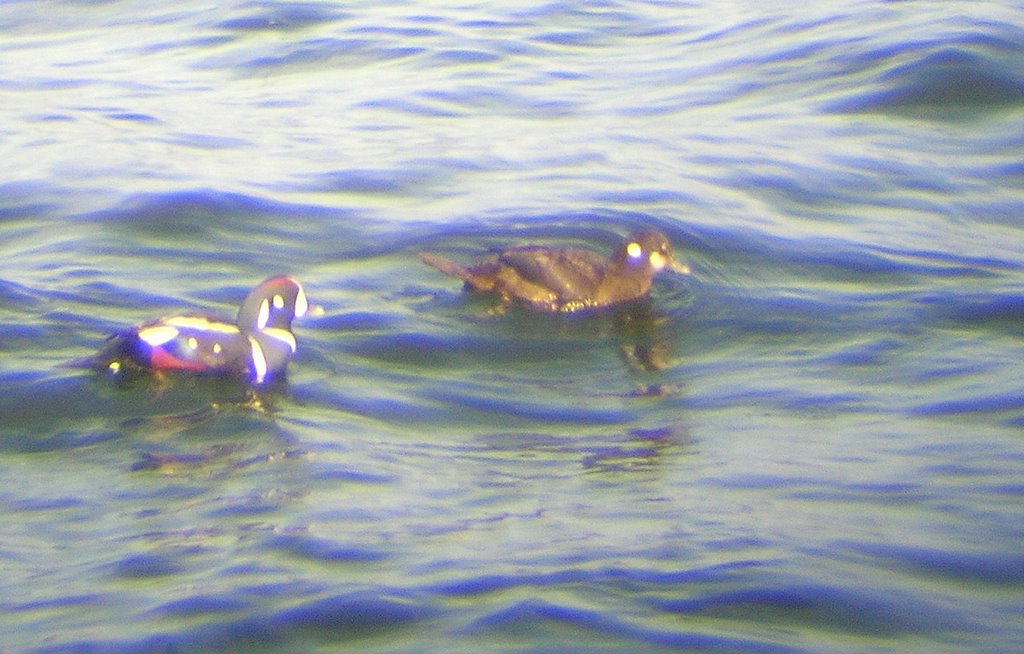
But all of these are forgotten when the Harlequin Duck pops into view. This bird just happens to be the most entertaining little guy that I know of. Luckily, it is reliably seen here off the coast of Massachusetts from November through March. This is a tiny duck with an outlandish pattern of white dots and crescents and splashes of rufous against its compact, dark body. It spends its time on rocky shores, playing about the crashing surf just inches from the seaweed and barnacle encrusted rocks, diving for mollusks and crustaceans, poking its head in the water, and skittering about the surface, playing with others.

Here’s to the Harlequin, at least until the next bird flies by.
Pictures were taken at Halibut State Park on Cape Ann, 11-26-06.

Saturday, November 25, 2006

Thanksgiving Pictures


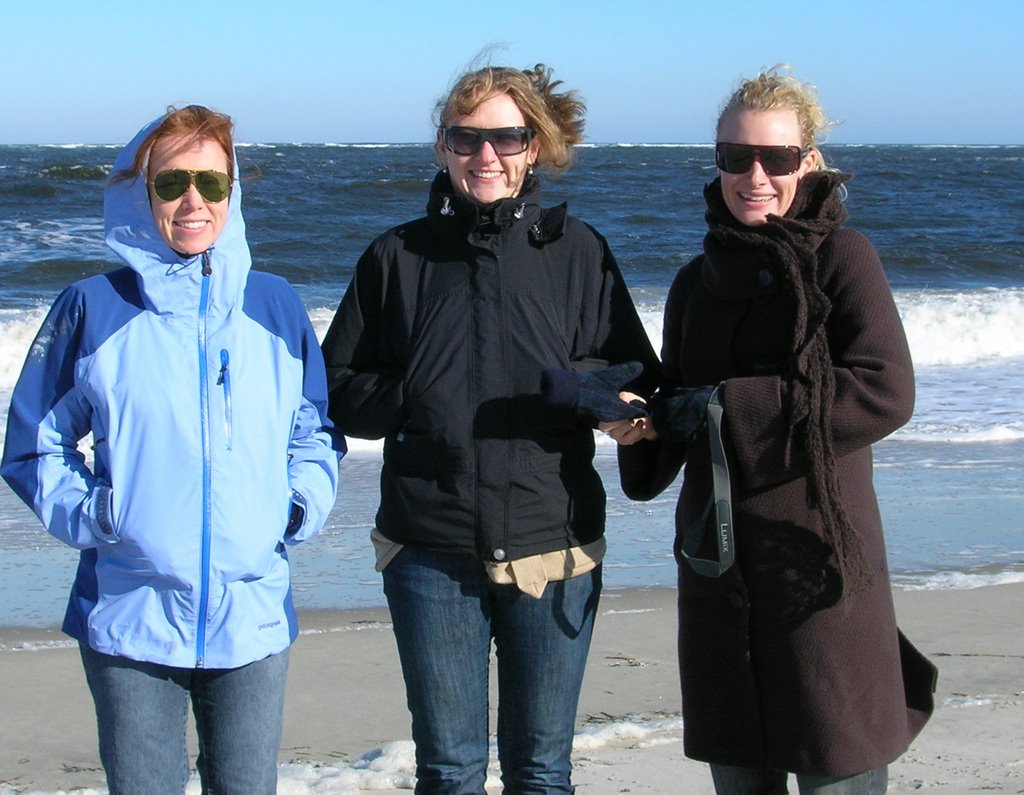
Who are these people? First picture: Anne, Anna, and Mathilde. Second picture: Mathilde and Anna. Third picture: Me, windblown. Fourth picture: who knows. Fifth picture: two rowdy crows.

I may be spelling Mathilde's name wrong.
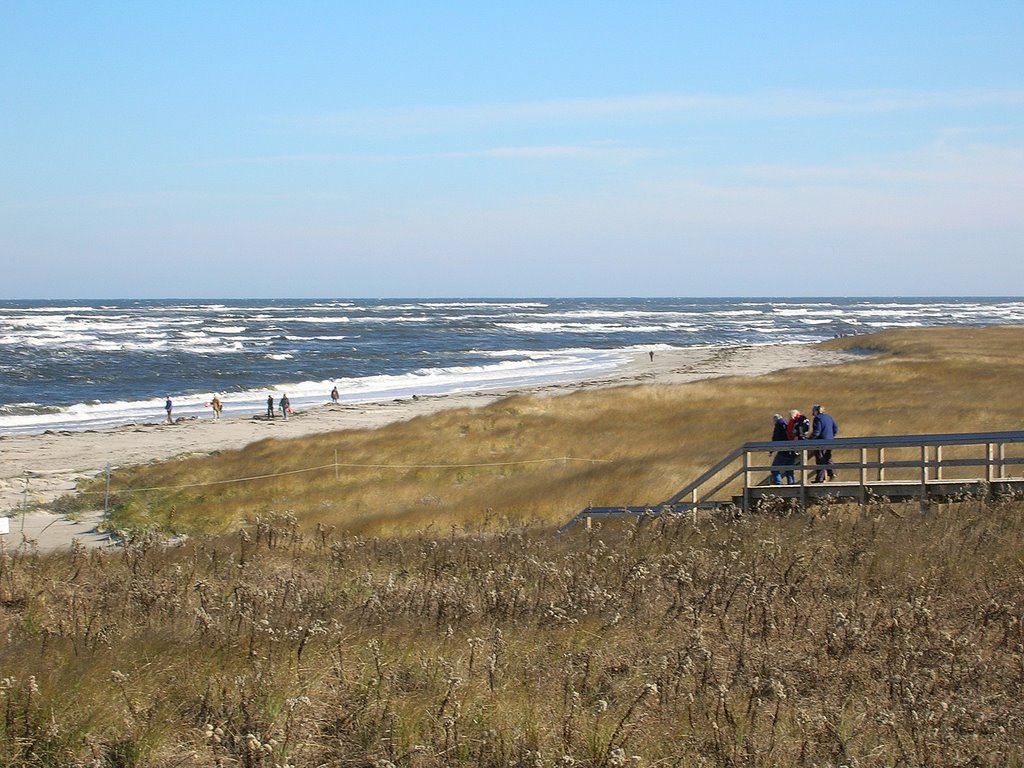
These pictures were taken in Ipswich, Massachusetts. The first four at Crane Beach. The crows were in some tree down the road.


Thursday, November 23, 2006

More Gabby Pictures


Well, the world probably has plenty of pictures of my beautiful little niece Gabriella, but I couldn't resist posting a few more. These are from Whitefish Bay, Lake of the Woods, Ontario, August 2006.
But don't forget to read my fascinating posting about Bluebeard's Castle below!

Bluebeard's Castle


I promised you Bluebeard’s Castle, didn’t I? I didn’t really intend to write about it, but I listened to this one-act opera of Bartok’s last night for the first time in many years and felt like saying something about it.

It’s an early piece of Bartok’s, written around 1910 or so, and is loosely based on an old fairy tale by Charles Perrault, Bluebeard, which concerns a murderous villain and his new young wife. He brings her home soon after they are married and forbids her to open a particular door in his castle, but of course gives her the key anyway, so…she opens it! And finds the dead bodies of his previous wives hanging on the walls. He finds out what she's done and chases her, intending to kill her, but she is rescued in the end by her brothers. A happy ending, I suppose, to a gruesome story.

Bartok’s story is similar – Bluebeard brings his wife home, where she sees there are seven locked doors. She is curious, but Bluebeard tells her they must not be opened, and makes a foreboding reference to ‘rumours’ about him. But she can’t let it go, and persuades Bluebeard to give her the keys to each room, and she opens them one by one. In the first we have a torture chamber, in the second an armory, the third, gold and jewels, the fourth, a beautiful garden, the fifth, grand vistas of Bluebeard’s lands, the sixth, a glittering fountain, and in the seventh…Bluebeard’s three former wives, but not really dead. They are living, and move about, but they don’t seem all that talkative (there are only two singing parts to the opera, Bluebeard and his wife, Judith).

What I find interesting is Bartok’s use of this story as an analogy, more or less, for a classic battle of the sexes. Though on the surface, (and clearly in the original folk tale), Judith is the heroine, Bartok’s point of view seems particularly sympathetic to Bluebeard. (Disclaimer: this is not just my own psychoanalysis; some of these thoughts were sparked by the liner notes, particularly the conductor Istvan Kertesz’s comments.) In fact, one can almost look at the story from a comical standpoint, as if it’s a modern sitcom. The guy, who just wants to love his wife and have her love him, but doesn’t really want to share too much or expose himself. He knows there are things buried in him (and in all men) which are not attractive. But his wife can’t leave him alone, she keeps pestering him to open up, which he reluctantly does, and eventually she drags out of him more than she can bear to know, and of course things end badly after that.

Now, I don’t want to analyze this too far; on the surface of things Bluebeard is a villain, and one certainly wouldn’t want to defend his crimes too much. But everything that is depicted falls very easily into metaphors for the life of a man and his relationship with the women he’s been close to, and Mr. Kertesz makes a very compelling, concise point: he says about Judith “She doesn’t want him, she just wants to open his doors.”

This brings up a lot of interest thoughts regarding relationships. All of us, I think, and maybe especially men?, have things in us which we don’t want to share, can’t share, ugly things, embarrassing things. In an ideal relationship we share as much as we can of ourselves, and are allowed to be ourselves as much as possible instead of playacting some other person, but still…there are some things better hidden, and finding that compromise with people you truly care about can be challenging. I don’t mean that we’re hiding violent crimes (in most cases) but we all put on at least slightly different faces when we are interacting with people than when we are alone, and often different faces for the different people we see. Or maybe it’s just me? It would be interesting to get a woman’s take on this story.

Regarding the music, it’s wonderful. Not yet in Bartok’s mature idiom, it has echoes of Strauss and Mahler, with a strong stamp of Bartok’s own developing personality, but it is very evocative and imaginative. The structure of the story is perfect for a series of small tone-paintings, as Judith opens each successive door to see something different. The garden brings forth a dense yet vibrant tapestry of verdant growth and birdsong, the grand vistas of Bluebeard’s estates ring with magisterial, swelling brass figures that seem to look across to the horizon, the fountain brings serene, drifting notes. When Judith becomes jealous and begins to ask Bluebeard about his former wives, you can hear a note of madness creep into her voice as she sings a thin monotone backed by dissonant strings edging against her notes.

And best of all, this is a short opera, about one hour long, and I was able to listen to the whole thing without falling asleep or letting my attention drift away!

Wednesday, November 22, 2006

Bartok's Fifth String Quartet


Here's a picture of me getting ready for a tramp in the woods.

No, actually, (as if I really fooled you), this is Bela Bartok getting ready for one of his groudbreaking forays into the Transylvanian countryside to collect folk music. Bartok was one of the first musicians to systematically collect, study and categorize folk music. What he heard and learned during his trips across the countryside of what used to be just Hungary and is now also Roumania and Czechoslovakia had a profound affect on the music he composed and on his thinking as a human being.

But I'm not really intending to write another biography of Bartok, as much as I think he led a fascinating life. I've been listening to a lot of his music lately, and in particular his string quartets, which are often (and justly) referred to as the 'new testament', the old testament being the quartets of Beethoven. I would like to urge anybody and everybody to give these a listen - get them out of the library if you don't already have them - especially the Fifth quartet, which is my personal favorite.

I've been trying to come up with a concise, intelligent way to describe this quartet and why I like it so much, but have been mostly failing to find the right words. It is a gentler and more austere quartet than the fourth, which may be his most well-known, but it is still full of the spiky character and strong dissonances that inhabit most of Bartok's work. Bartok himself could be spiky and dissonant by most accounts, but he was also a fierce idealist and compassionate humanist, a proud Hungarian yet universalist in his outlook, and these qualities also show in every measure of his music, and never more than in this piece. On a more specific note, if you listen to this quartet, note the five-movement structure of the piece, the affinities of the first movement for the last and the second for the fourth (the fourth movement is essentially a free variation of the second). Bartok never subscribed to any established system of composing but came up with plenty of his own.

Next stop, Bluebeard's Castle!

Monday, November 13, 2006

A Domestic Sunday in November


Hi Everybody! (Hi, Dr. Nick!)

I am very pleased to report that this afternoon I have baked the best loaf of bread, by far, that I have ever made myself. This doesn’t mean much, as I have probably baked somewhere around 6 or 7 loaves of bread in my life (not counting around 9 or 10 sweet quickbreads like banana or walnut). However, this was really a great loaf of bread, as good or even better than most high-end bakery breads that I can get. I owe it all to an article in last Wednesday’s New York Times Food Section by Mark Bittman, and I urge any and all interested parties to read it. Mr. Bittman was invited to the Sullivan Street Bakery in New York where the head baker/owner, Mr. Lahey, showed him an unusual method for baking an old-world style rustic loaf with a rich, flavorful crumb riddled with holes and a fabulously crackling crust.
Two aspects of the method are particularly noteworthy: instead of kneading the bread to develop the gluten, it relies on a long (12-18 hour) rising with a very small amount of initial yeast. This apparently develops the gluten quite satisfactorily with the added benefit of imparting great flavor from the long fermentation. The second unusual aspect is in the baking: the dough, after a secondary two-hour rising, is dropped into a preheated pot (such as a dutch oven) and covered for the first half-hour of baking, where it develops the crackling crust by baking within it’s own steam, mimicking the process of those expensive professional steam-injected ovens.
This was one of those articles that really excited me, and I immediately decided I would try it soon, but of course there was a hefty amount of doubt I had in it really working out so well. I was wrong. This was a wonderful bread. My results differed a little, I think, due to some inexperience and one small mistake. The second rising happens on a well-floured cotton towel, and I lost a bit of the dough in transferring it to the pot. I think this caused my loaf to be a bit small and a bit flatter – more like a ciabatta instead of the boule pictured in the NYTimes article. But who cares? It was a delicious ciabatta, if that’s what it was. My other little mistake, and I urge you not to do this, is that I was impatient and cut into the bread when it was still too hot and still steaming – so the interior crumb was a bit moist and gummy. It was still delicious and the texture quickly improved, mostly, but you should wait for the bread to cool down before you cut it, or at least until it’s warm and not still hot. If you can see the steam coming off of it, wait. You can easily reheat it later.
This is ideal as a dinner bread, for dipping in olive oil or spreading with butter, for sopping up sauces and throwing into soups. The crumb is too well developed with holes of all sizes to be used easily as a sandwich bread. I do look forward, however, to experimenting with mixing in some whole wheat flour and maybe some other grains and flours – flax seed, wheat germ, wheat berries – see if I can get a slightly healthier bread that I would also consider appropriate for breakfast toasting.
The article is most interesting and the recipe is very clear and easy, but here is a brief paraphrasing:
3 cups flour
1 ½ tsp salt
¼ tsp active dry yeast
Mix these well dry, then add 1 5/8 cup water – mix together thoroughly.
Put in a bowl and cover with plastic wrap, leave out in a warm dry place for 12-18 hours. (I went for 16). The dough should be bubbly and inflated. Turn out onto a floured board and fold over onto itself a couple of times (do not knead). Let rest, covered, for fifteen minutes. Flour a non-textured cotton towel and put the bread onto it, sprinkle with more flour on top and cover with another towel. Let rise for two hours. 30 minutes before baking, preheat the oven to 450 degrees with a 6 quart or so dutch oven inside it. When ready, pull out the oven and throw the dough into it. Cover and bake for thirty minutes, then uncover and bake for another 20-30 minutes, until well-browned on top (the browner the better, I say). Cool on a rack before cutting into it!

Enjoy! I wish I could share it with you right now.

Monday, October 30, 2006


Walden in fall!

Today is the last day of my ‘home’ vacation, and while I am not dreading work, I will definitely miss the time I have had this last week. Nobody who knows me should be all that surprised if I say that dividing my time between reading, writing, birding and cooking sounds just about perfect.

I made an effort to cook some interesting meals this week. I started last Sunday with a Potato Gratin from It Must Have Been Something I Ate by Jeffrey Steingarten. Very simple, and unusually he omits any cheese, insisting that if you do it properly, it will develop a cheesy flavor all on its own, just from the potatoes, cream and butter. He’s right, and it was delicious, though who’s to say it wouldn’t have been even cheesier with a handful of Gruyere browned at the top? On a slightly related note, I made myself polenta with butter and salt for breakfast yesterday, and it developed quite a cheesy flavor as well. Very tasty.

Monday afternoon I made Beef Bourguignon from Anthony Bourdain’s Les Halles Cookbook. Once again, this was a very stripped down recipe compared to several others I looked at, which is probably why I chose it. It was delicious, savory and silky, rich, the meat fork tender, the carrots soft and meaty. I think maybe I was expecting something a little more exotic, but after all, it is essentially just a beef stew with a slight French accent. I do wonder, however, if I had done the Gourmet Cookbook’s recipe, which called for brandy, dusting the meat in flour before browning and an entire bottle of wine (Les Halles used, adjusting total amount ratios, the equivalent of about a cup and a half), if it would have had a more refined and unusual flavor or texture. It also called for mushrooms.

Tuesday I followed the outline for Spaghetti with Clams from somewhere in Bill Buford’s Heat. Good, but not quite the glorious dish of pasta infused with the flavors of the sea I'd hoped for. The different liquids, the wine and butter and juice from the clams, just didn’t come together seamlessly, and I oversalted the dish just a touch. The clams themselves were perfect and still flavorful. Maybe I have to steam them more, extract more of their flavor into the pasta.

On Thursday I made a very simple Chicken Soup recipe from Irene Kuo’s The Key to Chinese Cooking. This was just a basic chicken broth (with the chicken), ginger, dried shiitake mushrooms, and my own addition of some baby bok choy, meant to be served with a dipping sauce of Soy, sesame oil and ground Sichuan peppercorns. Pull out chunks of food from the broth and dip, slurp soup – a very healthy, easy, delicious way to eat. I will fool around with this approach more during the winter months, I am sure.
Okay, that’s all I’m going to write now. If you’ve gotten this far, I hope you’ve enjoyed it!
-Brian

Saturday, October 28, 2006


Well, it's been a while. I seem to be slow getting this blog off the ground. Truly, I've been getting bogged down with the second draft of my book, The Vampire of Castle Esterhazey. Thankfully, I've just finished a very productive week that I took off from work, spending two or three hours daily on the project, and I've gotten a good handle on this mysterious process of revising and what it means for my story. I am going to go out on a limb and publish my personal goal of having a second draft complete by the end of the year. That will entail real work, however, and a daily commitment. I go back to work at Johnson's next week.
I've attached three pictures that I took through my scope (the snowy owl and the singing swamp sparrow) and through my binoculars (the great blue heron). The Snowy Owl was found at Plum Island March '06, the heron April '06 at the Broadmoor Audubon Sanctuary in Natick, and the lovely Swamp Sparrow was found May '06 on the western side of Quabbin Reservoir in central Massachusetts. I hope you enjoy these pictures, and look forward to uploading another post soon.
-Brian