Showing posts with label birding. Show all posts

Sunday, December 31, 2006

On the last day of 2006...Winter!


Winter finally blew in yesterday, not with a bang, and not exactly with a whimper, but with a modest two-inch snowfall and a chill deep enough to keep the ground white for a couple of days or so. Finally! The warm temperatures of the last month or two have been surprising, even among those of us sold on global warming long ago. I will admit that the warm November was enjoyable, but as it stayed mild well into December it started to seem strange, eerie and finally somewhat frightening, leading me to wonder if the anticipated global or regional climate change will happen not gradually over decades but in some crazy sudden ‘inversion’ that will instantly send our ecosystems spinning. Certainly, it has been an interesting month of birdwatching; from egrets to orioles, many birds have lingered that are normally long gone. I saw a great blue heron today flying across I-95.
So, the snowfall and the dry chill air feels most welcome. I like to think that the resident birds are enjoying it as well. I took a walk today at MassAudubon’s Ipswich River Wildlife Sanctuary and found that everywhere I turned, black-capped chickadees were buzzing about in a playful frenzy, picking their various ways through the winterscape, eking meals out from under leaf, between crevasses of bark, through clumps of snow, always keeping an eye out for a handout as well. They are tame here at Ipswich River, and they will land on your hand if you hold it out, whether it has food in it or not. So will the titmice.
It was sunny today, and other birds were active also, from a beautiful swamp sparrow foraging across the marsh boardwalks to a pair of soaring red-tailed hawks above the swallow field. Actually, my two best birds of the day virtually greeted me as I arrived at mid-morning: a vocal hairy woodpecker hopping along a tree on the edge of the parking lot, and just as I was making my way towards one of the back trails, a beautiful fox sparrow, my third of the year, and certainly a very beautiful bird, maybe (maybe) my favorite of the sparrows, if it isn't the grasshopper sparrow. Or the swamp sparrow.
I also brought along the Golden Guide to Trees today, thinking it would be useful, and enjoyable, to brush up on my tree identification skills which have gone largely dormant, and are more in tune with the Midwest selection anyway. I kept mostly to conifers today, for obvious reasons, and now I feel I know my way around Eastern White Pine, Eastern Hemlock and Eastern Red Cedar reasonably well. This ties in well with an excellent book I’m reading right now called Changes In the Land by William Cronin, which gives a fascinating history of the ecological changes that have occurred in the New England landscape from pre-colonial eras through the settling by Europeans.

It was nice, as usual, to get away from the noise and bustle of the city for a few hours, and the sound of snow crunching under my feet was a great bonus, expected but almost not expected in this strange Massachusetts winter. And a final prize: as I sit here writing this, I am hearing the low, nasal grunt of a fish crow, an uncommon species of crow distinct from the nearly-ubiquitous American crow, which gives me 205 bird species seen (or heard) in Massachusetts in 2006 (220 in North America, if you’re curious).

Now onto my New Year’s Even dinner, an indulgent splurge on a cheap but good cut of steak (chuck blade) and a California Petit Syrah, accompanied by mushrooms and bread.
Happy New Year!


Monday, December 25, 2006

Merry Christmas, Bird!


Well, once again my photography will not win me any prizes, but it is fun to document a bird here or there. This blurry little guy is a Northern Shrike, seen on Christmas day at the Parker River National Wildlife Refuge on Plum Island. I took it through my binoculars.
The Northern Shrike breeds far to the north and is mostly found around here in the winter. As it is ucommon to rare, as the field guides say, it is an uncommon to rare sighting, but made much easier by its habit of sitting at the top of exposed branches, trees or utility wire. It looks kind of like a mockingbird, but stouter, with a shorter tail and narrow black mask, barely visible in my photograph. I urge all interested parties to go look it up and take a gander; you might see one yourself someday, though in some parts it's easily confused with the Loggerhead Shrike, a close relative.
The Shrike is a powerful predator, taking prey of a size you wouldn't expect from a robin sized bird - I just read an account that had them occasionally taking Blue Jays, which are considerably larger than they are. I think small birds and rodents are more typical.
Anyway, Merry Christmas! I promise a blog about something other than birding soon.
-Brian
ps Some interesting, thrilling and chilling items I've culled from reading Scott Weidensaul's Raptor Almanac. In his discussion of a group of fossil raptors called teratorns, enormous avian scavengers related to condors, he says that the largest of these, and the largest flying bird ever, was Argentavis magnificens from the late Miocene, and that it stood as tall as a man and had a wingspan of around twenty-five feet. Compare that to the ten foot wingspan of modern condors. He goes on to mention, however, the flying reptile Quetzalcoatlus, which had a wingspan of thirty-six feet. Yikes. Finally, he mentions the largest eagle ever, Haast's eagle, which weighed an estimated thirty pounds (compare to about nine pounds for a golden eagle), and fed on moas, giant flightless birds of New Zealand, which were killed off about one thousand years ago. The eagles disappeared about the same time, but Weidensaul quotes biologist Jared Diamond as to his theory - the eagles may have been killed off by humans in self-defense, as the eagles were used to killing and consuming the enormous moas - two legged, strong, flightless birds between three and ten feet tall, and they probably could have made easy prey of the occasional Maori. Wow.

Thursday, December 21, 2006

Home Ground


Here on the first day of Winter, it’s nice to think of the warmth and promise of Spring, even if just for a few moments. Winter does have its charms, but Spring…I was looking through a few pictures I had taken this last April in a local park I often visit, and thinking about how nice it is to have a place nearby that you visit frequently, that you know well, that comforts you and surprises you in the ways that an old and good friend or family member will.
Having been somewhat unsettled through much of my adult life, there’s no place I go now that I’ve known intimately for all that many years. Many people talk of the relationships they’ve had with places throughout their entire lives, or throughout large chunks of their adult lives, but I just don’t really have that. However, for the last three years, since moving to Newton, I have had Hammond Pond.
Hammond Pond, and the adjoining Webster Conservation Area, is a wonderful and surprisingly wild and varied park in central Newton, straddling both sides of the Hammond Pond Parkway, just north of two separate mall complexes in Chestnut Hill. Though I’ve explored both sides, the east side that includes Hammond Pond itself is the place I usually go. It’s on my way to work, and easy to stop off at for a few minutes (or few hours, if I get up early enough) of birding and tramping about before clocking in. The pond itself, which borders the mall parking lot on the south and an inaccessible red maple swamp to the north, often harbors surprises for those who take the time to scan the water and the trees bordering this small lake. The water is often full of ducks, geese and gulls; in the Spring wood ducks are always present paddling and dabbling along the western shore, and can often be found sitting in nearby trees as well. Before and after ice out there are usually numerous hooded mergansers diving for fish. Two weeks ago I saw one struggling with a sunfish as big as its head; as if that wasn’t enough trouble it was soon attacked by a herring gull which forced it to dive again and again, always resurfacing with the fish still in its beak. Eventually it made its way over to the water’s edge; the gull gave up as it hid itself in the overhanging brush there and finally consumed its enormous meal. Great blue herons are often seen here, ospreys not so often but on a few occasions.
Entering the woods you quickly pass beautifully sculpted cliffs of Roxbury pebblestone that sometimes hold climbers on the weekends. When the palm warblers arrive, usually among the first warblers to do so, they jam this stretch of trees in considerable numbers and think nothing about going about their business not ten feet away, singing their feeble trill and constantly flicking their tail as they forage in the low, open undergrowth.
Just a few minutes of walking brings you to a short dip down into the Webster Conservation area, where a small, clear brook babbles along into a wetland area, a peat bog. Skunk cabbage abounds, and this is usually the first place I spot migrating hermit thrushes, hiding in plain sight in their peculiar and endearing manner. This wetland appears wildly different at different times of year, or even from day to day according to the amount of rain we've been getting. Sometimes it is lush and picturesque, full of frogs and swimming ducks, herons and kingfishers. Other times it is a dank mudpit, and sometimes it appears as a dry, stubbly field bunched with clumps of brown marsh grass along its margins. Once again wood ducks are dependable if there is water to be found. There are always song sparrows, but that is no surprise. I have seen, twice, a coyote trotting along the train tracks on the far side. And some incredible, unseeable species of frog makes the most amazing, bubbling, endless trill in the early mornings, one frog harmonizing with another at strange, jarring intervals.

Moving along, before I cross the train tracks there is a little spot up from the wetland where I look and usually find an ovenbird skulking about the logs and leaf duff in early May. Crossing the tracks finds me in the Houghton Gardens, a more manicured garden area with benches, carefully placed stone steps and small arched bridges over narrow, shallow waterways. Warblers are plentiful here.

Coming back, I skip the wetland and instead head up along a back trail to the top of the bluffs we passed earlier, finding myself in perhaps the most surprising place of all, a rolling open shelf of rock and thick, verdant moss, with views over the high ledges to the pond and swamp below. This place never fails to thrill me with its fragile beauty and unexpected character; the dense heterogeneity of this entire property is a marvel, surrounded by residential neighborhoods, highways and shopping malls, five miles down the road from Boston.


Sunday, December 17, 2006

An important milestone we should all celebrate. Not really.


I tell myself, and others, that as a birder, I’m not all that interested in numbers or obsessive ‘listing’, as it’s often called. Simply, listing is making a list of the birds that you’ve seen. Easy enough, no big deal. The most basic form is the ‘life list’ – a list of all bird species that you have ever seen. Many people take it one or two, or ten or twenty, steps further. There are country lists, state lists, city lists, park lists, backyard lists, lists of birds seen on television, bird calls heard on television or radio, birds referred to in books or poetry. Then there are year lists, month lists, behavior lists (singing, feeding, copulating…), the possibilities are endless. This, along with the mental and physical challenge that is a real part of birding, is what makes it kind of a sport, and what spurs many people to bird competitively, trying to rack up as many species as they can, sometimes in conscious competition with other birders (the most famous competitions are the ‘big day’ and the ‘big year’ – you can probably guess what these mean).

As I said, I don’t really consider myself a die-hard lister, most of the time. I have a life list, and I keep a year list, and I keep records of species seen on most outings I take. But I don’t tend to drop what I’m doing in order to chase down one rare bird, and I don’t make much of an effort to tally as many species as I can in a year, or even a lifetime. I’ve got other things I also like to spend time on, though birding is near the top of the list. In this way, I sometimes think of myself as a ‘birdwatcher’ instead of a ‘birder’, being more interested in watching the birds and learning about them, enjoying their beauty and the intricacies of the world they fit into rather than quickly checking them off and moving on to the next.

This is somewhat true of myself, but also somewhat false. Today I found myself birding with moderate fervor, and a specific goal in mind: to reach two hundred species in Massachusetts for the year 2006.

I was successful.
A few weeks ago, I looked over my year checklist and found that, after having birded frequently in the Spring but not having done much since then, I had seen about 180 species in Massachusetts for the year, and remembered telling myself that it would be nice to reach or break 200. So I thought, ‘I can do this.’ Over the next couple weeks I added new birds here and there, some waterfowl species at the Great Meadows National Wildlife Refuge in Concord one weekend, a couple of sparrow species at Nahanton Park in Newton another, meadowlarks (which I had somehow missed in the Spring, despite their lovely song "springtime is here") at MassAudobons Daniel Webster Wildlife Sanctuary last weekend…

This morning my tally stood at 196. One thing I hadn’t done all year, either this Fall or last Winter, was hit Gloucester and Rockport (except for Halibut Point, which I visit frequently, but often to go snorkeling rather than birding). There are a lot of wonderful birds to be had in Gloucester, but it’s not usually my favorite type of birding, as Gloucester is pretty well developed and birding mostly involves driving from site to site, getting out of the car and scanning with binoculars or scope along the way. I generally prefer to pick a location where I can get out and hike or walk for some distance. But like I said, there are good birds to be seen in Gloucester, and some more likely to be seen there than any other place around here.

I started at the Fisherman’s Monument by Gloucester Harbor, and found the wind blowing in from the south quite fiercely, making holding my scope steady or even my binoculars difficult. I found some common eider and red-breasted mergansers, but didn’t have the patience or will to really clamp everything down and scan from there for the uncommon gull species that I’ve seen there before.

So I moved on, and that paid off. At the State Fish Pier the wind was still fierce but it was just a bit more sheltered and I could crouch by my car to steady myself (at least it wasn’t cold). Almost immediately I had a tremendous view of a female scaup, a type of waterfowl, paddling and diving around a floating wooden dock laden with a motionless cadre of double-crested cormorants. There are lesser and there are greater scaup, and with both female and males it is hard to distinguish between the two species, but this bird was close and stayed close as long as I was there, and between the larger bill size and the shape of its head, peaked in front, calling it a greater scaup was fairly easy.
One down!
Next I began to scan gulls, never one of my favorite birding activities. Gulls mostly all look alike, but there are two straightforward things you can do to zoom in on most of the rarer ones in New England, at least in Winter. Look for very small gulls, and look for larger gulls with no dark brown or black markings on their wingtips. These latter are what we call the 'white-wing' gulls, consisting mostly of Iceland and Glaucous Gulls.

Success, and two down! Another great view, this time of an Iceland gull, a mid-sized gull that winters here in modest numbers, amidst the many thousands of ring-billed, herring and great black-backed gulls that abound in these parts, nowhere more so than the Gloucester Harbor.

I then moved south along the eastern shore of Gloucester Harbor to eastern point, where I saw nothing new for the year, but did see a sizable flock of purple sandpipers on the big jetty there, more hordes of gulls, more eider and a small group of the fun-loving buffleheads. Driving out from the point I stopped at Niles Pond where there was a nice flock of bonaparte’s gulls, to my eyes an exceptionally elegant small gull with a fine black bill. I don’t often see these resting so placidly on a pond, usually I’m trying to make out the field marks on a considerable chop out at sea, so I took my time looking at them and making mental notes about plumage and shape.
This was not a new bird for the year, but a friendly birder at the pond reminded me of a rarity that has been haunting that neighborhood the last week or so, a western kingbird, a large flycatcher usually seen, as if you couldn’t guess, in the west, but a rare but regular vagrant across the eastern United States. So I found a parking spot by the beach and walked over to 10 St. Louis Street off of Farrington, and almost immediately found it preening itself high in a bare tree just below a small congregation of house finches. Superficially this bird resembles a great-crested flycatcher, which is easily found in Massachusetts woodlands during the Spring and Summer, but has more dark/light contrast between its head and chest and a noticeable black line across its eye. It also holds itself more horizontally. Despite belonging to the flycatcher family, this one has been eating berries (though with our warm weather so far, I'm sure there are plenty of flies still around. Ticks, too). Plus, one thing you learn, if you see a bird you don’t expect for the time of year, look more closely – it might be a completely different kind of bird that’s completely off your radar, a vagrant from worlds away.

Three down!
The last bird was the most fleeting but the most exciting, as it was a bird I’ve been hoping to catch a glimpse of for years but never have until today, the lovely oddball, the flying football, the dovekie. This is a type of alcid, a group of tubby ocean birds usually draped in bright white and black that normally stay well away from land, diving endlessly for their meals, at least when they're not breeding. These are the penguins of the north, but they can fly, barreling along just above the surface of the water with considerable speed, if not much grace. The dovekie is the smallest alcid in the east, and the tubbiest as well. It really is quite small, and I nearly mistook it for a sandpiper at first from its size, but noticed right away its distinctive shape (football) and coloration (tuxedo) and manner of flying. If it had been off on the horizon, I may not have been able to judge size or shape well enough to really distinguish it from another type of alcid like a razorbill (or I wouldn’t have been able to see it at all), but it was pretty close in, maybe a hundred, hundred and fifty yards out or so, flying south past the Granite Pier in Rockport into the small bay there. I watched it for about six or seven seconds, heart thumping, hoping to see it splash down and get a chance to watch it feed. No such luck. I suddenly lost it, mysteriously, in mid-flight in the sun’s glare on the water. I scanned for maybe fifteen or twenty minutes more, but could not turn it up again, but…it had to be there, somewhere.

No big deal. Four down, and a lifer for my 200th Massachusetts bird species seen in 2006.
Happy Holidays!
(p.s. the photograph has nothing to do with this post. I didn't take any pictures today, but feel that a photograph might help people enjoy my blog, so I included one of my favorite pictures from Costa Rica 1990. It's a picture of a damselfly.)

Monday, December 11, 2006

Winterberry and the misfit goose


Winterberry is one of the standouts of the wintry New England coastline, often providing the only splash of bright color amidst the muted browns, greens and tans of dune, scrub and field. I love in particular their contrast against the small dark green juniper shrubs when they grow together in the shallow, stable depressions between windswept dunes. By mid-winter they often seem to be the only berry still available, and an important foodstuff for wintering birds and animals that enjoy berries. Myself, I’ve never tried one. I did notice signs posted at the entrance to the Parker River National Wildlife Refuge today to leave the berries alone. I think, however, that they are often collected for holiday decorating, not as a tasty addition to your yogurt.
Birding today was a little quiet, especially once the drizzle began around nine o’clock or so. I missed most of the more exciting birds posted on the chalkboard – the shrike, the owls, the Eurasian wigeon and the kittiwakes. I had to make do with excellent, close views of several other expected but enjoyable species, including Common and Red-throated Loons, Red-necked and Horned Grebes, Common Goldeneyes, all the scoters, the Common Eiders…and a few other things.
Interesting behavioral note: I watched a group of seven female Common Goldeneyes for several minutes. They always dove as a group, either all at once or in quick succession, and surfaced quickly, usually within six or seven seconds, which is shorter than most of the other diving birds, I think. I wonder what sort of group hunting formation they use, collaring schools of small fish and driving them towards each other. What a cold observation project that would be!
Northern Harriers seemed to be everywhere, and I still have yet to have a dull moment watching them hunt and they wobble and drift above the marshes. Most of the individuals seem to be immatures, showing that beautiful reddish wash on their breast. I also had great views of a Cooper’s Hawk along the roadside.
The bird of the day was the Snow Goose, a single individual grazing amidst a large flock of Canada Geese. I included a picture here to demonstrate my great skills at photography. Despite its blurriness, I think you can see the diagnostic black wingtips and maybe the pinkish color of the bill, maybe not. You can see that its white, and clearly not a Canada Goose, can’t you?


Monday, December 04, 2006

Snowy Owls!


Man, when I get the birding bug, I really get it. After a very full Spring of almost daily trips near and far throughout eastern Massachusetts, I went several months with only a trip or two every few weeks plus some incidental roadside and vacation birdwatching (thus missing the heights of the fall shorebird, sparrow and raptor migrations). But with the end of the year approaching, it got into my head to see if I could bolster my list to 200 species seen in Massachusetts this year, and I've been out nearly every day for over a week. Though I haven't really done the job I need to if I want to add species - there are rarities to be chased down on Cape Cod, and a full swing through Cape Ann might turn some things up, but alas, I have to work and there have been other (albeit enjoyable) commitments preventing me from going at it full time on the weekends. And now it's snowing! (Plus laundry, library, clean room and kitchen, practice violin, rehearsal, grocery shopping...) But I just can't get the birdies off my mind, have several guides by my bedside that I am leafing through idly.

I should go chase the Bell's Vireo down in Falmouth, but...an hour and a half drive each way, an unknown location and unclear directions, a possibly several hour wait with no guarantee of success for one bird, well...I'm just not up to it today. Not without company. Too much driving. Why does that make me feel guilty? Less than dedicated? To those birders who might be reading this whose perseverence stretches beyond my own: my apologies.

In compensation, here are two photographs of the Snowy Owl that I saw yesterday at the Salisbury Reservation on the northern mouth of the Merrimack River. My friend Anne has a sixth sense for these wonderful birds and spotted it on a dumpster as we were leaving the park. It soon flew (the first time I've ever seen a snowy fly in ten-plus sightings!) and perched for several minutes on the maintenance building where we got some pictures. Otherwise, it was quiet at Salisbury, but a few nice birds were about - Long-tailed Ducks, Eider, Common and Red-throated loon, Red-Breasted Mergansers...the short-eared owls hadn't arrived yet.

Did I mention that it's snowing?

Monday, November 27, 2006

Harlequins!


You know, as a birder, and as a person, I try not to play favorites. It’s a fun exercise, no doubt, and the kind of top-ten list making that starred in the novel High Fidelity can easily consume hours of idle thought. But really, I find that these favorites are in a constant state of flux, changing by the year, week, day, or minute. Often, my favorite is whatever is staring me in the face at that particular moment, which is as it should be. A few things certainly stay near the top of the list for long periods of time. For me, musicians such as the Beatles and Mozart, movies like Jaws and ET, books like The Lord of the Rings and Dune will always be near the top.

Birds are different. I have so many favorites. There are birds such as the Black-capped Chickadee, which reliably entertain me with their familiar chatter and antics at any time of year. I see them almost every time I venture outside, and they are familiar friends. There are birds like the Wood Thrush, which send a thrill through my ears and my soul when I hear one for the first time every Spring, singing with a voice at one with the heart of spring and the woods, but also speaking from just on the other side of some parallel world beyond my reach. That was a little over the top, wasn't it? And of course there are the memories or anticipations of rare thrills I get from such birds as razorbills or phalaropes.

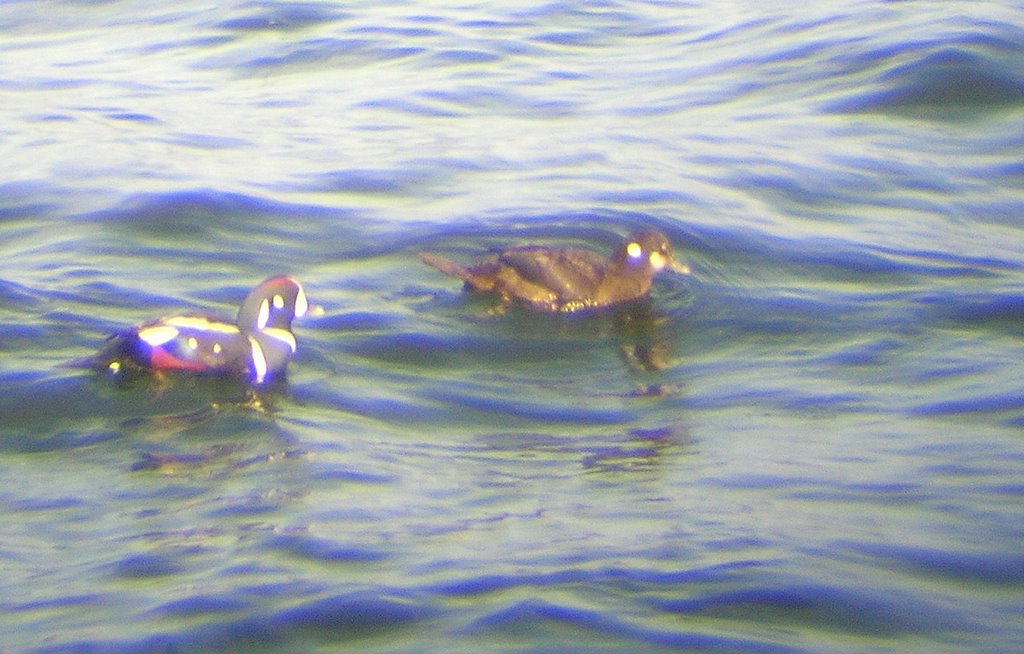
But all of these are forgotten when the Harlequin Duck pops into view. This bird just happens to be the most entertaining little guy that I know of. Luckily, it is reliably seen here off the coast of Massachusetts from November through March. This is a tiny duck with an outlandish pattern of white dots and crescents and splashes of rufous against its compact, dark body. It spends its time on rocky shores, playing about the crashing surf just inches from the seaweed and barnacle encrusted rocks, diving for mollusks and crustaceans, poking its head in the water, and skittering about the surface, playing with others.

Here’s to the Harlequin, at least until the next bird flies by.
Pictures were taken at Halibut State Park on Cape Ann, 11-26-06.